
The best fruits for gut health aren't just good for you - they taste amazing. But what fruit is best for gut health? We'd be here all day if we listed our favorites, so we boiled it down to just our top five picks:
- Apples
- Bananas
- Berries
- Kiwis
- Pomegranates
Gut health fruits should be just one piece of your diet, though. Don't overlook the role of vegetables like carrots, beets, leafy greens, ginger, artichokes - the list goes on and on. We'll highlight all our favorite foods for gut health below.
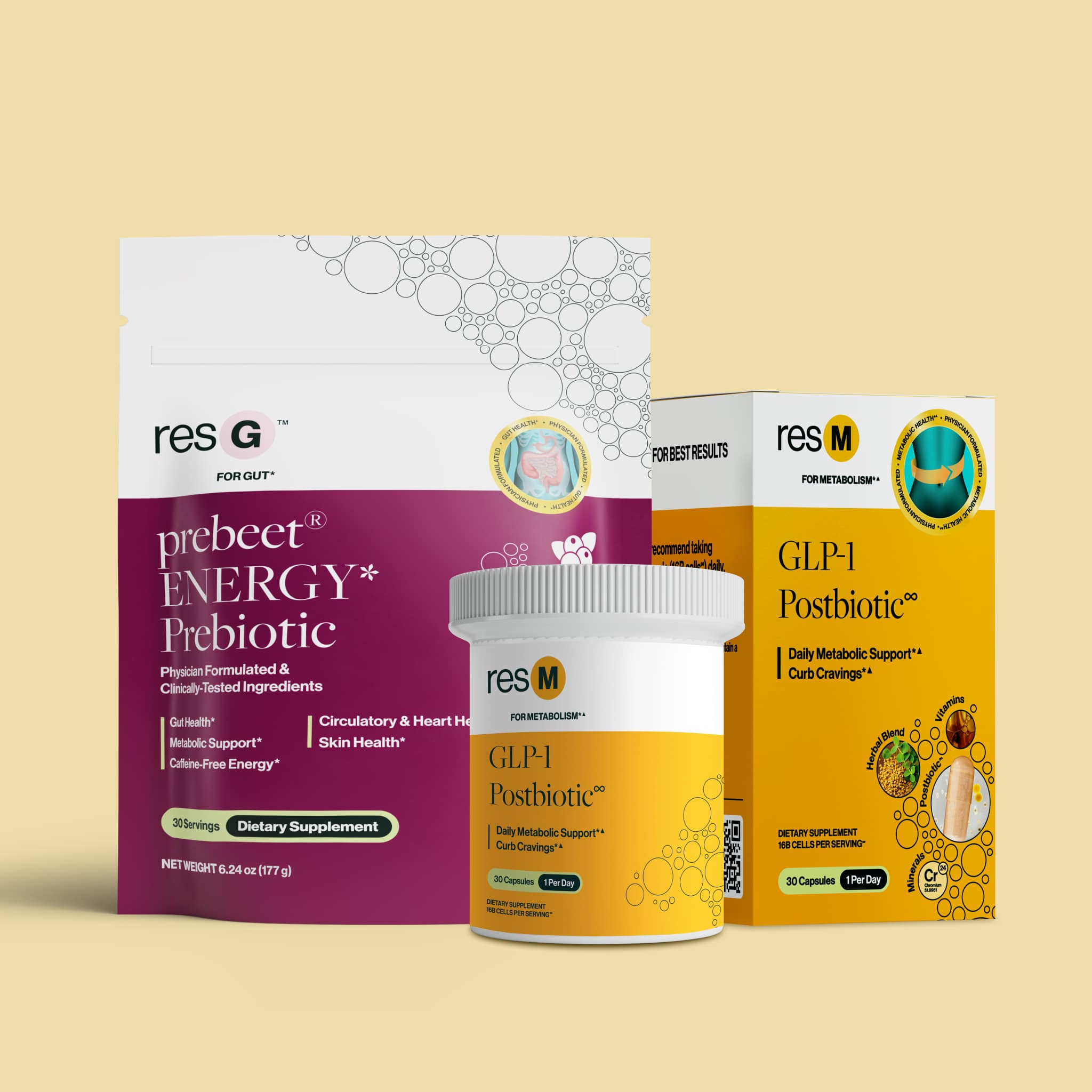
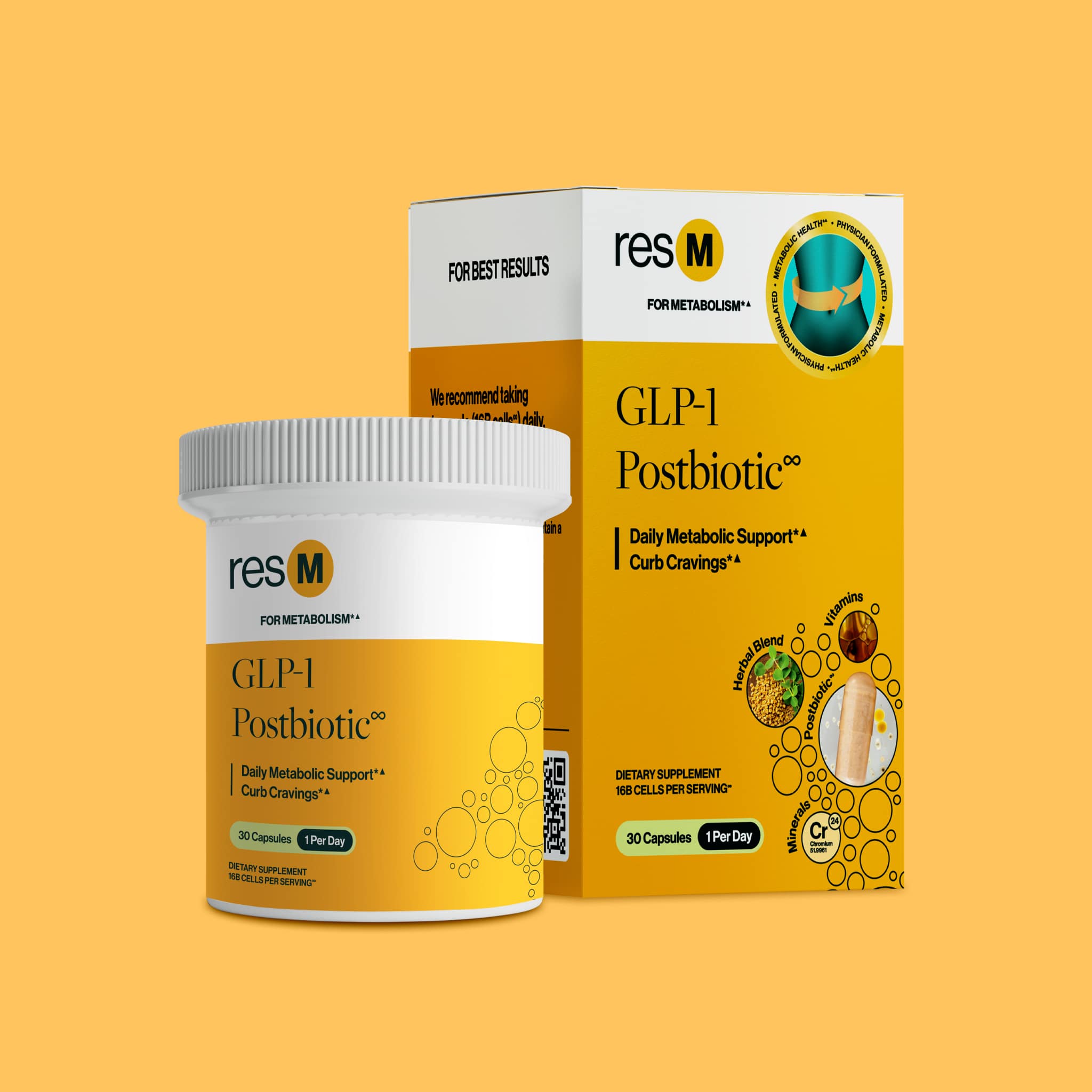
You can also fill in nutritional gaps with a targeted supplement for gut health, like resM. It's a GLP-1 probiotic that brings together clinically-studied ingredients like postbiotics, vitamins, and herbs. Learn more about the science behind resM today.
What Fruit is Best For Gut Health? Our Top 5 Gut Health Fruits
It wasn't easy, because we had to leave out some of our personal favorites - but we narrowed it down to the five best fruits for gut health. A few honorable mentions first:
- Avocados
- Pineapples
- Papayas
- Oranges
- Mangoes
These can all have a place in your diet, too. But what fruit is BEST for gut health?
Apples
Eat the peel. That's where the pectin is - about 4.5 grams of fiber in a medium apple, split between soluble and insoluble.¹ You won't find many snacks that cover both in one shot.
The skin holds most of the polyphenols too.² So if you've been peeling your apples - stop.
Bananas
Green or ripe? Matters more than people think. Greener bananas have more resistant starch. Once they go spotty and sweet, most of that starch has converted to sugar. Ripe ones are gentler on a sensitive stomach, though - pick based on what you need that day.
Bananas also have inulin - one of the better-studied prebiotics out there.³ Plenty of potassium too.⁴ Go for one that still has some green left.
Berries
Raspberries have the edge - 8 grams of fiber per cup.⁵ Almost a third of your daily target from one handful. Blueberries and blackberries aren't far behind. Whichever berry you'll eat most often wins.
Those deep colors come from polyphenols.⁶ Blueberries have gotten the most research attention so far, especially around anthocyanins.⁷ Frozen work just as well as fresh - buy the big bag.
Kiwis
Kiwis don't get talked about enough. Two a day made a measurable difference for bloating in clinical settings.⁸ They carry an enzyme called actinidin that no other common fruit has. Protein doesn't break itself down. Actinidin handles that.
They're also fiber-dense relative to their size,⁵ and the vitamin C alone in two kiwis exceeds what you'd get from an orange.⁹ Eat the skin if you can tolerate it - more fiber, less waste.
Pomegranates
Messy to eat. Worth it anyway. The arils are where the polyphenols are - specifically ellagitannins, which have been showing up in gut lining research more and more over the past few years.²
Plus the fiber in the seeds themselves.⁵ If cracking a whole one open sounds like a chore, the pre-packaged arils work. Just avoid pomegranate juice as a substitute - you lose the fiber.
Don't Forget to Eat Your Veggies, Either!
The best fruits for gut health only cover half the plate. Vegetables fill in what fruit can't - different fibers, different prebiotics, some nutrients that don't show up in the fruit aisle at all.
Cruciferous Vegetables
Broccoli, cauliflower, Brussels sprouts, cabbage. Sulforaphane is the standout compound.¹⁰ These are also some of the best foods to support Akkermansia out there - this being the bacterial strain that keeps showing up in microbiome research. Cook them however you want.
Leafy Greens
Spinach and kale have a sugar called sulfoquinovose - almost nothing else in your regular diet provides it.¹¹ Toss a handful into whatever you're eating at lunch.
Carrots
They cost next to nothing and every store carries them year-round. Solid soluble fiber.⁵ Eat them raw when you can. Cook them if you prefer, but you'll lose some of that fiber structure.
Beets
Beets are one of the better food sources of betaine. If you tend to bloat after meals, that's worth knowing.¹² Roasted beets taste better than boiled ones.
Sweet Potatoes
Cook a batch and let them cool before eating. The resistant starch goes up once they're cold. About 4 grams of fiber per medium one. That cooled starch becomes prebiotic.¹³ Good excuse to meal prep them on Sunday and eat them cold in salads all week.
Ginger
Not a vegetable - it's a rhizome. But close enough when it comes to gut health. If you've ever had ginger after a heavy meal and felt your stomach settle, that wasn't placebo.¹⁴ Grate fresh ginger into hot water. The ginger ale at the grocery store doesn't count.
Artichokes
Jerusalem artichokes - sunchokes - are one of the richest sources of inulin you can eat.¹⁵ Globe artichokes from the grocery store have less, but still bring real prebiotic value. Start with small portions on sunchokes if you've never tried them. They can cause gas until your gut adapts.
Bottom Line on the Best Fruits For Gut Health
What fruit is best for gut health? Anything with fiber and polyphenols. If it's also prebiotic, even better. Apples and kiwis are the two we'd tell someone to start with if they're only going to change one thing. Pair those with a few servings of the vegetables above and you're on the right track.
That said, getting enough vitamins for gut health from food alone takes real planning. A targeted postbiotic like resM can fill gaps - particularly around GLP-1 support and metabolic function - while your diet handles the fiber and polyphenol side.*
References
- Jiang T, Gao X, Wu C, et al. "Apple-Derived Pectin Modulates Gut Microbiota, Improves Gut Barrier Function, and Attenuates Metabolic Endotoxemia in Rats with Diet-Induced Obesity." Nutrients. 2016;8(3):126. PMC
- Wang X, Qi Y, Zheng H. "Dietary Polyphenol, Gut Microbiota, and Health Benefits." Antioxidants. 2022;11(6):1212. PubMed
- Hughes RL, Alvarado DA, Swanson KS, Holscher HD. "The Prebiotic Potential of Inulin-Type Fructans: A Systematic Review." Adv Nutr. 2022;13(2):492-529. PMC
- Anyasi TA, Jideani AIO, Mchau GRA. "Functional Properties and Postharvest Utilization of Commercial and Noncommercial Banana Cultivars." Compr Rev Food Sci Food Saf. 2013;12(5):509-522. PubMed
- Slavin J. "Fiber and Prebiotics: Mechanisms and Health Benefits." Nutrients. 2013;5(4):1417-1435. PubMed
- Xue H, Sang Y, Gao Y, et al. "Research Progress on Absorption, Metabolism, and Biological Activities of Anthocyanins in Berries: A Review." Antioxidants. 2022;12(1):3. PubMed
- Lavefve L, Howard LR, Carbonero F. "Berry Polyphenols Metabolism and Impact on Human Gut Microbiota and Health." Food Funct. 2020;11(1):45-65. RSC
- Gearry R, Fukudo S, Barbara G, et al. "Consumption of 2 Green Kiwifruits Daily Improves Constipation and Abdominal Comfort — Results of an International Multicenter Randomized Controlled Trial." Am J Gastroenterol. 2023;118(6):1058-1068. PMC
- Richardson DP, Ansell J, Drummond LN. "The Nutritional and Health Attributes of Kiwifruit: A Review." Eur J Nutr. 2018;57(8):2659-2676. PubMed
- Bouranis JA, Beaver LM, Jiang D, et al. "Interplay between Cruciferous Vegetables and the Gut Microbiome: A Multi-Omic Approach." Nutrients. 2022;15(1):42. PMC
- Hanson BT, Kits KD, Löffler J, et al. "Sulfoquinovose Is a Select Nutrient of Prominent Bacteria and a Source of Hydrogen Sulfide in the Human Gut." ISME J. 2021;15(9):2779-2791. PMC
- de Oliveira SPA, do Nascimento HMA, Sampaio KB, de Souza EL. "A Review on Bioactive Compounds of Beet (Beta vulgaris L. subsp. vulgaris) with Special Emphasis on Their Beneficial Effects on Gut Microbiota and Gastrointestinal Health." Crit Rev Food Sci Nutr. 2021;61(12):2022-2033. PubMed
- Liu M, Li X, Zhou S, et al. "Dietary Fiber Isolated from Sweet Potato Residues Promotes a Healthy Gut Microbiome Profile." Food Funct. 2020;11(1):689-699. PubMed
- Nikkhah Bodagh M, Maleki I, Hekmatdoost A. "Ginger in Gastrointestinal Disorders: A Systematic Review of Clinical Trials." Food Sci Nutr. 2018;7(1):96-108. PubMed
- Ramnani P, Gaudier E, Bingham M, et al. "Prebiotic Effect of Fruit and Vegetable Shots Containing Jerusalem Artichoke Inulin: A Human Intervention Study." Br J Nutr. 2010;104(2):233-240. PubMed
*These statements have not been evaluated by the Food and Drug Administration. This product is not intended to diagnose, treat, cure, or prevent any disease.