







Glucosamine vs collagen for joint pain might seem like choosing between two very similar solutions, but the real story is more nuanced than meets the eye.
- Glucosamine is involved in cartilage maintenance pathways and has been studied for its role in supporting joint comfort, particularly in populations experiencing age-related cartilage wear.
- Collagen provides the structural protein your body actually uses to build cartilage, tendons, and ligaments. It has benefits beyond joint health for skin and nails, too.
So is collagen or glucosamine better for joints? They work through totally different pathways to support joint comfort, so this isn’t exactly apples to apples. But, there’s a stronger body of evidence in favor of glucosamine.
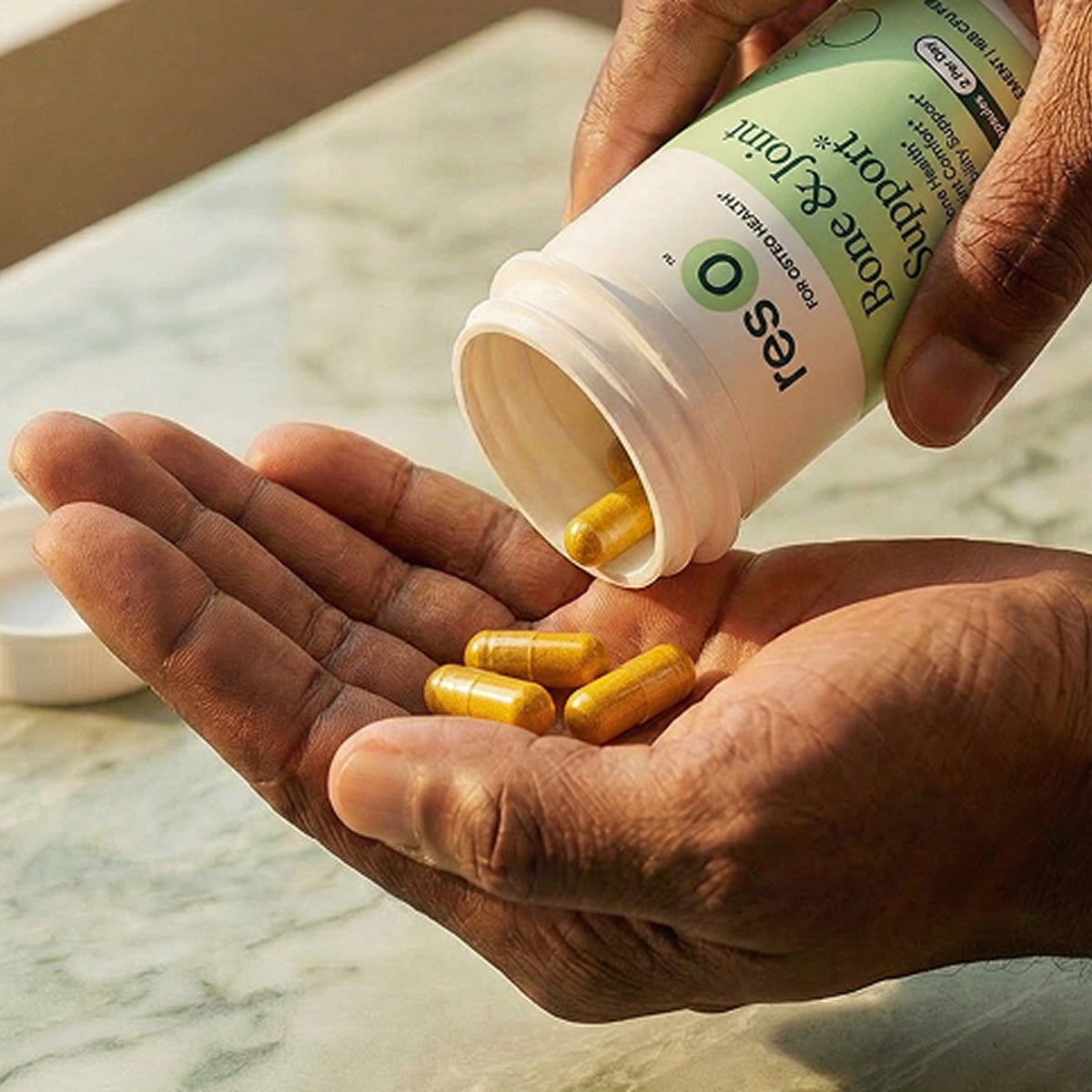
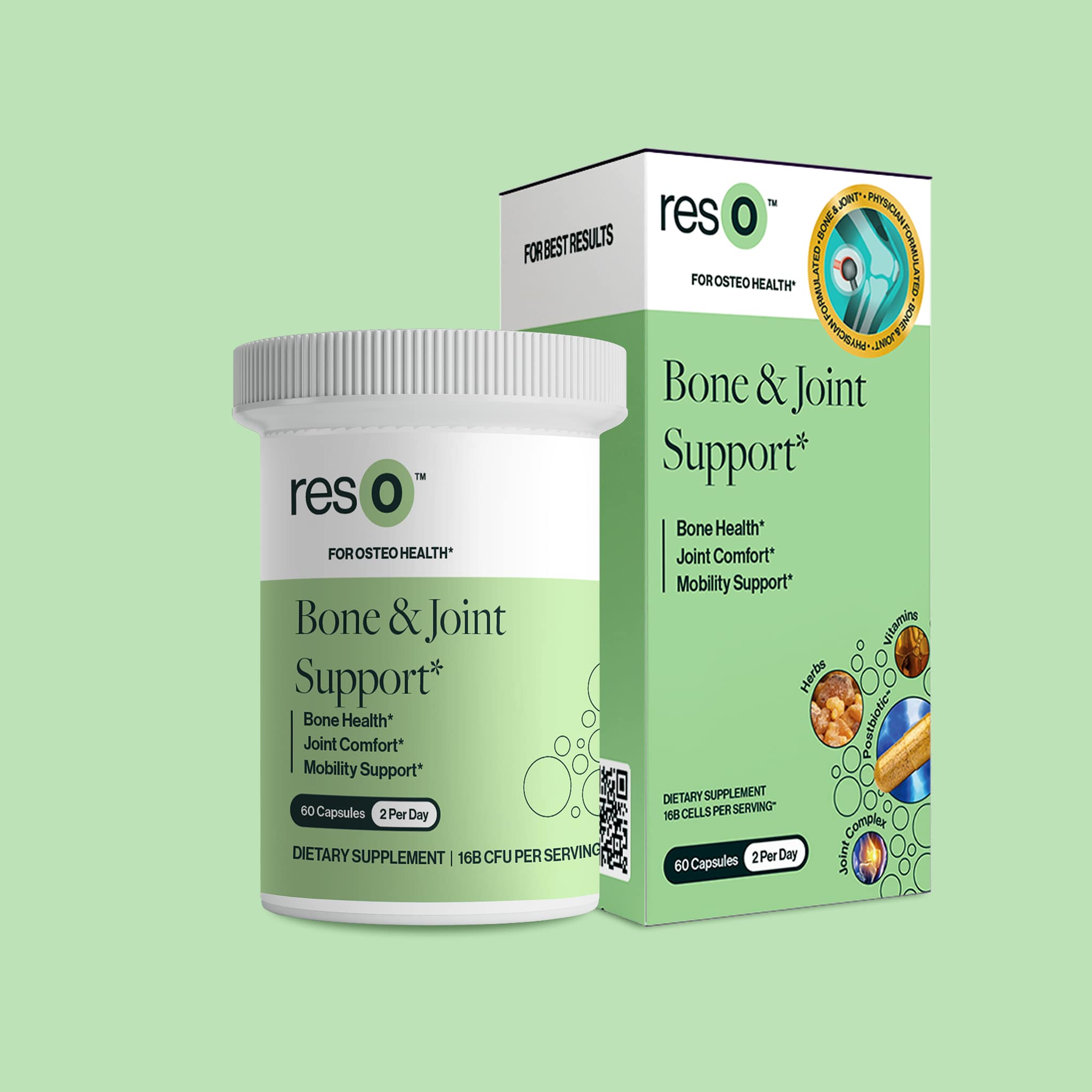
resbiotic’s resO® Bone & Joint Support Postbiotic brings together glucosamine, postbiotic L. Plantarum RSB11, chondroitin, MSM, boswellia serrata, curcumin, vitamin D, and bromelain for the most well-rounded bone and joint support osteobiotic on the market.*
Learn more about glucosamine vs collagen below, or find out what resbiotic’s resO can do for your body!
Quickly Compare Collagen vs Glucosamine
|
Factors |
Collagen |
Glucosamine |
|
Primary Action |
Structural protein building blocks for cartilage, tendons, and ligaments |
Supports cartilage maintenance and joint cushioning pathways |
|
Best For |
Overall joint structure, flexibility, athletic recovery |
Osteoarthritis, chronic joint degeneration |
|
Results Timeline |
4-12 weeks for noticeable improvement |
8-12 weeks for reported improvements in joint comfort |
|
Typical Dosage |
10-15g daily (hydrolyzed collagen) |
1,500mg daily (often with chondroitin) |
|
Research Support |
Growing evidence, particularly for Type II collagen |
Extensive studies, especially for knee osteoarthritis |
|
Common Sources |
Bovine, marine, chicken (Type II) |
Shellfish shells, synthetic (vegetarian options) |
|
Side Effects |
Possible digestive upset, allergies |
Mild GI issues, may affect blood sugar |
|
Additional Benefits |
Skin elasticity, hair/nail health, gut support |
Primarily joint-specific |
How Collagen Supports Joint Health
Collagen makes up as much as 60% of your cartilage by dry weight. That tells you everything about why it matters for joint health. Think of it as the structural framework that holds everything together. It’s the protein scaffold that makes cartilage strong and resilient.
Your body produces collagen naturally, but production drops dramatically after age 25, declining by about 1-1.5% each year. This is why the older you get, the more stiff you feel - and the slower you are to recover. Your cartilage is thinning, and your joint cushioning is diminishing.
Type II collagen specifically targets joint cartilage, while Type I (the most abundant in your body) supports tendons and ligaments. Most hydrolyzed collagen supplements consist of amino acids (glycine, proline, and hydroxyproline). Your body uses these to synthesize new collagen tissue.
Research shows collagen peptides get absorbed into the bloodstream and accumulate in cartilage, where they can stimulate your own collagen production and support the extracellular matrix that keeps joints functioning smoothly.
How Glucosamine Supports Joint Health
Glucosamine plays a totally different role than collagen. It’s not a structural protein itself. It supports cartilage maintenance instead. This naturally occurring compound lives in your joint cartilage and synovial fluid, where it encourages smooth movement and cushioning.
Glucosamine supports glycosaminoglycan production. These molecules support cartilage in the form of water retention. They also help it stay resilient under stress. This is really important because cartilage doesn’t have a very strong blood supply, and thus, has a harder time keeping its structure with age or repeated pressure.
Research suggests consistent glucosamine intake may help delay cartilage breakdown and keep joints moving comfortably for longer. These studies involved a pairing of glucosamine and chondroitin or MSM, two other important compounds for healthy joints.
A lot of joint supplements on the market use glucosamine sulfate specifically because it has the most research for people dealing with stiffness and osteoarthritis-related discomfort. That’s why it’s the form used in resbiotic’s resO Bone & Joint Support Postbiotic. .
Glucosamine vs Collagen For Joint Pain: Side-by-Side Comparison
So, is collagen or glucosamine better for joints? You can see that each brings something to your joint support regimen, but the differences become crystal clear when you compare glucosamine vs collagen for joint pain side-by-side.
How They Work
The differences between collagen vs glucosamine start with their mechanisms of action.
Collagen brings your body the amino acids it relies on to build connective tissue like cartilage, tendons, and ligaments. It supports structural integrity over time.
Glucosamine doesn’t necessarily help build new cartilage. It protects what’s there already. It works closer to the joint surface to keep cartilage resilient and lubricated. This can influence how joints feel when you move, be it your knees, ankles, or anything in between.
Speed of Results
You want to feel better fast - but neither is a “painkiller.” These are long-term solutions for joint health. That said, there’s little difference between glucosamine vs collagen in terms of speed.
Collagen forms new tissue, and that takes time. Most people find that it can take up to 12 weeks before any positive changes occur. Glucosamine sulfate can take anywhere from three to eight weeks for symptom improvement, according to similar studies.
So is collagen or glucosamine better for joints as far as the timeline to feeling better goes? In this case, it appears that glucosamine can have a positive impact sooner.
Bioavailability and Absorption
Bioavailability is everything with oral supplements. This speaks to how easily your body can absorb and use a compound. So, which has a higher rate of absorption between glucosamine vs collagen for joint pain?
Hydrolyzed collagen peptides are broken down into smaller amino acid chains so they can be absorbed and used throughout the body fairly easily. But, glucosamine sulfate is a form the body already recognizes, so it can get right to work in cartilage-support pathways. That could be why it tends to work faster than collagen.
Potential Side Effects
You have little to worry about in terms of side effects between collagen vs glucosamine. Both are fairly well tolerated. It mostly depends on the source and dosage you’re taking.
Some people point out a bit of digestive discomfort with some collagen supplements. On the other hand, glucosamine can cause minor GI issues in some people. It’s often derived from shellfish, which is an important piece of context for anyone with allergies.
Either way, it’s best to start with the recommended dose to avoid unpleasant reactions.
Accessibility
There is no shortage of collagen and glucosamine supplements on the market these days.
Collagen powders are the most common form of supplement you’ll come across. They’re easy to add to drinks or meals. But mixing powder is generally seen as less convenient than capsules.
In contrast, glucosamine mostly comes in capsule or tablet form. It’s most often paired with chondroitin or MSM for more complete joint support. Take resbiotic’s resO, for instance. It includes all three of these ingredients along with:
- Postbiotic L. Plantarum RSB11®
- Boswellia serrata
- Curcumin
- Vitamin D
- Bromelain
That’s really the key takeaway on what to take for sore muscles and joints. The more angles you can support your joints from, the better!
So is Collagen or Glucosamine Better For Joints?
In looking closely at glucosamine vs collagen side by side, we think it’s a somewhat easy choice. Collagen can provide general connective tissue support, but glucosamine tends to have a stronger body of evidence for stiffness tied to cartilage wear.
You can technically add both to your arsenal!
resbiotic’s resO modulates the Gut-Bone-Joint Axis, a key communication pathway linking the gut microbiome to skeletal and immune function.* It supports healthy inflammatory signaling, bone turnover, and tissue repair for a well-rounded approach to skeletal and joint health.*
Bringing Our Comparison of Glucosamine vs Collagen to a Close
We hope this comparison of glucosamine vs collagen for joint pain has left you feeling clear on what each brings to the table and which is right for your body - be it one or the other, or both!
In closing, collagen gives your body what it needs to build connective tissue. Glucosamine protects the connective tissue you have. To some extent, the comparison of collagen vs glucosamine is a comparison of correction vs prevention.
But these are just two of the many ingredients used in joint support regimens. resbiotic’s resO brings glucosamine together with postbiotic L. plantarum RSB11®, chondroitin, MSM, boswellia serrata, curcumin, vitamin D, and bromelain in one comprehensive formula. Add it to your arsenal today to support stronger joints, smoother movement, and more confident recovery.*